
By Charles West August 24, 2026
Some of the most expensive ecommerce fraud does not look suspicious at checkout. The authorization succeeds, the order looks normal, tracking shows delivery, and the chargeback may not appear until the real cardholder discovers the transaction weeks later.
That delay is what makes triangulation fraud, reshipping scams, and other forms of card-not-present fraud especially difficult for merchants. The payment decision happens first, while confirmation that something went wrong may arrive only after inventory has left the warehouse and the package has reached its destination.
The sequence often looks like this:
Fraudulent Order Looks Normal → Merchant Authorizes and Ships → Goods Are Delivered or Forwarded → True Cardholder Notices Transaction → Dispute/Chargeback Arrives Later → Merchant Absorbs Product, Shipping, Fees, and Operational Loss
A successful authorization is important, but it is not proof that the person placing the order is the legitimate cardholder. Authorization generally means the issuer accepted the authorization request based on the information and risk signals available at that moment.
Visa describes authorization as a separate stage from authentication, with the issuer deciding whether to approve or decline after evaluating the account, transaction, and related risk information.
For merchants, the practical lesson is straightforward: ecommerce fraud detection cannot depend on a single field, one security result, or whether an order “looks normal.”
Effective payment fraud prevention combines payment signals with customer history, device behavior, shipping information, order velocity, fulfillment controls, authentication, and post-transaction analysis.
This guide explains how to recognize those relationships without treating unusual customers as criminals, exposing fraud-rule thresholds, or creating so much checkout friction that legitimate shoppers leave.
What Is Triangulation Fraud?
Triangulation fraud is an ecommerce fraud pattern involving multiple parties, including an unsuspecting shopper, a fraudulent seller or intermediary, a legitimate merchant, and the actual owner of compromised payment credentials.
At a high level, the unsuspecting shopper believes they are buying legitimate merchandise. The fraudulent party may then cause a separate purchase to be placed with a real retailer using unauthorized payment credentials.
The legitimate retailer sees an apparently ordinary ecommerce order, receives an authorization, fulfills it, and may not know anything is wrong until the genuine cardholder reports the unauthorized transaction.
The critical merchant issue is not the criminal mechanics of the scheme. It is that legitimate-looking fraudulent orders can contain many elements normally associated with good purchases: a deliverable address, realistic contact information, ordinary product quantities, and normal shipping.
This creates a dangerous gap between transaction approval and eventual fraud discovery.
A merchant may see:
- an authorization approval;
- a valid-looking customer profile;
- merchandise going to an actual deliverable location;
- normal carrier tracking;
- successful delivery; and
- no immediate customer complaint.
Several weeks later, the genuine cardholder may review an alert or statement, report that they never authorized the purchase, and initiate a dispute.
That makes ecommerce triangulation fraud fundamentally different from obvious attacks involving nonsensical addresses or immediately rejected credentials. The merchant needs enough contextual visibility to recognize relationships among payment, account, device, destination, and fulfillment information.
The broader evolution of digital payment scams also reinforces why ecommerce businesses need layered controls rather than assuming every successfully authorized online purchase represents a trusted customer. For additional background, this overview of how payment scams have evolved discusses the changing fraud environment merchants face.
What Is a Reshipping Scam?
A reshipping scam involves merchandise being delivered to an intermediary location or recipient before being forwarded elsewhere. The recipient handling the package may be knowingly involved, or may themselves have been deceived.
The FTC’s guidance on reshipping scams explains that these schemes can involve merchandise purchased with stolen credit-card or bank information and sent through intermediary recipients.
The U.S. Postal Inspection Service warns that reshipping schemes can involve packages purchased with stolen debit or credit cards and sent to people who are then instructed to forward them. The FBI’s Internet Crime Complaint Center has documented similar schemes involving compromised payment credentials and intermediary recipients.
For merchants, the important signal is not simply that a package goes to a forwarding address. Legitimate freight forwarders, package-receiving businesses, corporate mailrooms, family members, students, travelers, military customers, and gift recipients can all create unusual shipping patterns.
Risk becomes more meaningful when the shipping information is evaluated together with other evidence.
For example, a first-time customer shipping to a package-receiving location may deserve review when the same destination has recently appeared across unrelated accounts or payment methods. That still does not prove fraud, but it creates a cross-order relationship worth investigating.
Unexpected address changes can also matter. A customer requesting a delivery modification after payment may have an innocent reason, but a high-risk transaction combined with an unusual rerouting request deserves additional attention before the merchant or carrier changes the shipment.
The safest approach is therefore not “block freight forwarders.” It is to ask whether the destination fits the rest of the customer, payment, device, and order history.
Triangulation Fraud vs. Reshipping Fraud
These categories overlap, but they are not interchangeable.
| Fraud Pattern | Main Characteristic | Merchant Risk |
| Triangulation fraud | A deceptive intermediary is connected to an order ultimately funded with unauthorized payment credentials | Merchant may ship a legitimate product and later receive an unauthorized-payment chargeback |
| Reshipping fraud | Merchandise passes through an intermediary recipient, forwarding service, or unexpected destination | Goods may become harder to recover while payment fraud is discovered later |
| Ordinary stolen-card fraud | Unauthorized card details are used directly for a purchase | Merchant may lose merchandise and transaction revenue |
| Friendly fraud | The genuine customer or household disputes a transaction that may actually have been authorized | Prevention depends more heavily on customer recognition, documentation, and dispute evidence |
| Legitimate drop shipping | An authorized seller has a genuine commercial relationship with a supplier that ships to the customer | Normal business activity when payments and commercial relationships are legitimate |
This distinction matters because the correct prevention strategy depends on the underlying cause. True stolen-card fraud requires stronger authentication and pre-fulfillment detection. Friendly fraud often requires clearer descriptors, customer communication, account history, and stronger dispute documentation.
Why Fraudulent Ecommerce Orders Can Look Completely Normal

Many merchants expect fraud to be obvious. In reality, sophisticated online payment fraud frequently looks ordinary because the attacker is interacting with the same checkout, inventory, payment gateway, and shipping infrastructure used by legitimate customers.
The order value might fall within the merchant’s typical range. The email address may appear normal. The shipping location may accept packages every day. The customer may select standard delivery instead of making an unusually urgent request.
Even security results can appear reassuring.
An AVS response may be favorable. A security-code check may succeed. The issuer may approve the authorization. None of those signals independently establishes that the person operating the browser is the rightful cardholder.
There are also many innocent reasons for unusual checkout data. Someone may order a birthday present for another person, make a corporate purchase from a home internet connection, buy while traveling, or have merchandise sent to a workplace.
This is why modern ecommerce fraud detection should consider relationships, not isolated attributes.
A useful review model asks questions such as:
- Does the customer have a credible history with the business?
- Is the device consistent with previous activity?
- Is the destination appearing across unrelated accounts?
- Have several payment credentials been associated with closely related orders?
- Is this order materially different from the customer’s normal behavior?
- Did the account or delivery information change shortly before the purchase?
- Does the fulfillment request fit the overall transaction context?
The goal is not to accumulate red flags until a customer “looks guilty.” The goal is to identify combinations of signals that justify stronger authentication, additional verification, manual review, or cancellation.
Why Chargebacks Can Appear Weeks After Purchase
The delay between shipment and dispute is one of the most damaging characteristics of stolen card ecommerce orders.
A typical timeline is:
Order → Authorization → Shipment → Delivery → Cardholder Statement or Alert → Fraud Report → Issuer Dispute → Chargeback
The true cardholder may not notice the transaction immediately. Some consumers review account activity constantly, while others discover unfamiliar purchases only when checking a periodic statement, receiving a banking alert, or investigating another account problem.
The merchant’s experience can therefore be misleading. The order may have been fulfilled successfully, the package may have been delivered, and no complaint may have arrived from the person who interacted with the merchant.
Then the dispute appears.
There is no universal number of days after purchase when a fraud chargeback will occur. Network rules, dispute category, issuer processes, merchant circumstances, and applicable deadlines vary.
Merchants should rely on their current acquirer, processor, and card-network requirements rather than building operations around a single assumed timeline.
This delay also changes what merchants must preserve. By the time a chargeback arrives, customer-service agents may no longer remember the order, browser logs may have expired, shipping information may have been archived, and temporary fraud-screening data may have disappeared.
The FTC’s online-shopping guidance also emphasizes keeping transaction records such as purchase details, receipts, payment information, shipping promises, and customer communications
A strong retention program keeps appropriate transaction and fulfillment evidence accessible for the period required by applicable network, processor, business, security, and legal obligations.
Useful records may include transaction references, authentication results, permissible AVS information, account history, shipping records, customer communications, device-risk results, and prior undisputed transaction relationships.
For more context on the financial consequences, see this discussion of the true cost of chargebacks beyond the disputed sale.
Authorization Is Not Fraud Validation
This distinction deserves special emphasis because it is responsible for many avoidable ecommerce losses.
Authorization approval does not prove that the buyer is genuine.
Authorization is part of the payment process. The issuer evaluates the authorization request and decides whether to approve or decline it. The issuer may consider account status, available credit or funds, transaction information, risk models, authentication data, and other factors.
But authorization cannot answer every merchant-specific question.
An approval does not necessarily establish that:
- the person controlling the shopping session is the legitimate cardholder;
- the shipping recipient has been authorized by the cardholder;
- the merchant account has not been compromised;
- the purchaser’s email or phone belongs to the true cardholder;
- the destination is trustworthy; or
- the transaction will never be disputed.
Authentication adds additional confidence but also should not be treated as magical proof. Visa’s current explanation of EMV 3-D Secure distinguishes authentication, which helps verify customer identity, from authorization, when the issuer makes the approve-or-decline payment decision.
A mature merchant therefore separates two internal decisions:
- Should the payment attempt be submitted and accepted?
- Should the merchandise actually be fulfilled based on the overall fraud risk?
For many ordinary low-risk purchases those decisions occur almost instantly. Higher-risk merchants, expensive merchandise sellers, or businesses with persistent reshipping fraud may need an additional fraud decision between authorization and fulfillment.
That short review window can be one of the most valuable controls in the entire fraud program.
Card-Not-Present Fraud Risk and the Signals That Matter
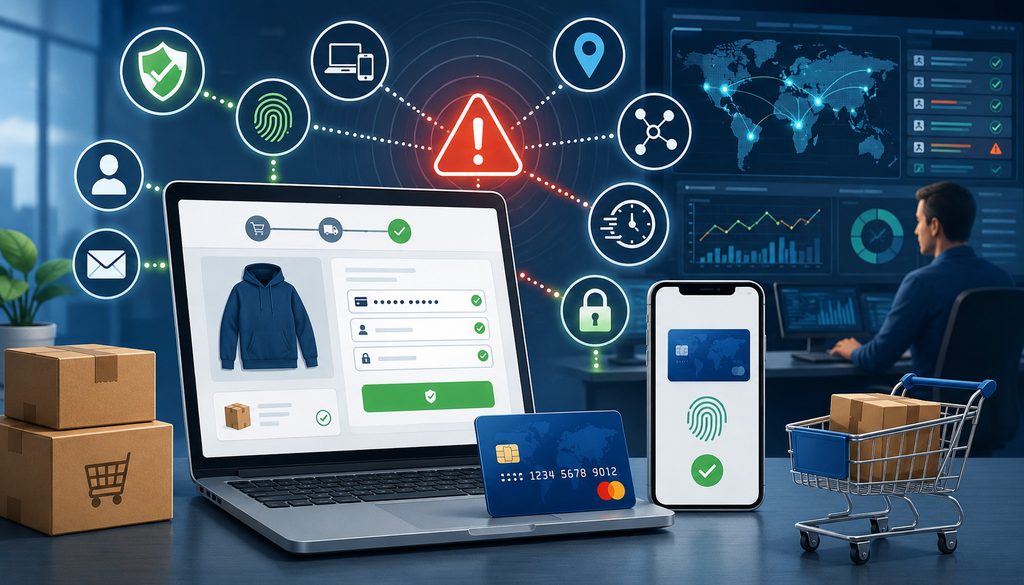
Ecommerce is a card-not-present environment. The merchant does not receive the same physical interaction that can occur in a traditional in-person purchase, so fraud controls must obtain context in other ways.
A useful layered model combines payment information, account behavior, device intelligence, order history, identity consistency, shipping data, velocity, authentication, and fulfillment characteristics.
AVS and Billing-to-Shipping Differences
Address Verification Service can provide useful information about how submitted billing details compare with information available to the issuer. Its exact responses and support vary by network, issuer, processor, geography, and transaction setup.
The correct interpretation is:
AVS Match ≠ Proof of Legitimate Cardholder
AVS Mismatch ≠ Automatic Fraud
Billing and shipping differences are similarly ambiguous. A customer may send a gift, ship merchandise to an office, order for a family member, or use a legitimate forwarding company.
A mismatch becomes more significant when it appears with additional fraud risk signals, such as an unfamiliar device, newly created account, repeated payment attempts, or a destination connected with several unrelated identities.
Merchants should therefore record AVS outcomes where their systems and provider permit, but avoid building a binary approve/decline strategy around AVS alone.
CVV and Sensitive Authentication Data
A correct card verification value can improve confidence that the person placing the order has access to the value presented during checkout. It still does not prove the transaction is authorized by the true cardholder.
More importantly, merchants must handle security-code data correctly.
PCI standards prohibit ordinary merchants from storing card verification codes after authorization. The same principle applies to other sensitive authentication data such as full track data and PIN or PIN-block information.
PCI materials explicitly classify the card verification value, full track data, and PIN information as sensitive authentication data that non-issuing entities must not retain after authorization.
Fraud investigators should retain the result provided by the payment system when permitted—not the customer’s CVV itself.
3-D Secure
EMV 3-D Secure adds an authentication layer to ecommerce by allowing richer information exchange among the merchant, issuer, and other participants before authorization. EMVCo describes the protocol as supporting issuer and merchant efforts to combat card-not-present fraud while enabling risk-based and customer-authentication experiences.
Visa Secure is Visa’s implementation of EMV 3DS. Visa states that the technology helps issuers authenticate cardholders and can provide fraud-liability protection for qualifying authenticated or attempted-authentication transactions, subject to applicable program rules and transaction conditions.
That qualification is important. Merchants should not assume every 3DS transaction automatically transfers every form of liability.
3DS also does not eliminate account takeover, merchant error, first-party misuse, fulfillment abuse, or every possible form of payment fraud.
Merchants considering stronger authentication may also find this overview of EMV 3DS and ecommerce fraud controls useful.
Device, IP, Velocity, and Cross-Order Pattern Detection

Payment information tells only part of the story. Fraud becomes easier to identify when merchants analyze relationships across sessions and orders.
Device intelligence can help determine whether an account is behaving consistently. A device repeatedly appearing across otherwise unrelated customer profiles, for example, may deserve review. Likewise, a long-established customer suddenly transacting from a completely unfamiliar environment while changing other account details could justify additional verification.
Device data should not be interpreted mechanically. Customers replace phones, share family computers, use workplace equipment, clear browser data, and shop across multiple legitimate devices.
IP addresses and geolocation carry similar limitations.
Mobile carriers, VPNs, corporate networks, shared internet connections, privacy technologies, university networks, and travel can produce locations that do not neatly align with the billing or delivery address. Blocking every IP mismatch would generate substantial false positives.
Velocity analysis looks for repeated activity across a defined period, but merchants should avoid publishing exact fraud-rule thresholds. Useful dimensions include:
- repeated payment attempts;
- multiple payment methods associated with connected orders;
- unusual bursts of purchasing;
- repeated customer accounts sharing common attributes;
- repeated shipping destinations;
- repeated devices or contact details; and
- abrupt changes from established customer behavior.
The value comes from cross-order pattern detection. One order may appear harmless in isolation. Ten unrelated accounts sharing a suspicious combination of device, destination, contact, or fulfillment characteristics may reveal a pattern.
Fraud platforms should allow investigators to move from individual transactions to these broader relationships without automatically declaring every linked customer fraudulent.
Shipping Address Analysis, Forwarders, and Fulfillment Risk
Shipping information is especially important in triangulation fraud and reshipping fraud because the merchant’s inventory eventually leaves its control.
A destination can be residential, commercial, a package-receiving service, a freight forwarder, a hotel, a dormitory, a corporate mailroom, or another legitimate location. No category should automatically determine fraud.
Instead, merchants should evaluate whether the destination fits the customer’s broader history.
A long-standing customer who regularly uses the same forwarding company presents a different risk profile from several newly created accounts using unrelated payment credentials but converging on the same unfamiliar destination.
Reshipping and Freight Forwarders
Legitimate freight forwarding is a normal part of global commerce. Some customers depend on forwarders because merchants do not ship directly to their region or because international businesses consolidate deliveries.
The presence of a forwarding address should therefore initiate context-sensitive analysis, not an accusation.
Consider the combination of:
- historical customer behavior;
- payment authentication;
- device consistency;
- account age;
- previous successful transactions;
- order velocity;
- destination reuse; and
- customer communication.
A forwarding address with strong history and consistent identity may be perfectly reasonable. A forwarding location connected with many unrelated new accounts and changing payment methods deserves closer examination.
Mid-Transit Address Changes
Delivery changes after shipment deserve particular care because the merchant’s original fraud review was based partly on the original destination.
An address-change request may be completely legitimate. Customers make mistakes, travel unexpectedly, or realize they will not be available to receive the package.
The question is whether the change is consistent with the order and customer history.
Merchants can establish documented rules governing who is authorized to change a destination, which carrier capabilities are allowed, when additional confirmation is appropriate, and when an order should instead be returned or canceled. Those controls should reduce unauthorized rerouting without unnecessarily inconveniencing ordinary customers.
No Single Red Flag Means Fraud
One of the fastest ways to create an ineffective fraud program is to convert every unusual characteristic into an automatic decline.
Fraud systems operate in an environment full of legitimate exceptions.
A student may order from a parent’s card and have merchandise delivered to campus. A traveler may purchase from a foreign IP address. A company employee may use a corporate card while shipping equipment to a remote worker. A gift may naturally involve different billing and shipping addresses.
Military customers, freight-forwarding users, digital nomads, temporary workers, and people moving homes can all generate data that appears inconsistent.
That is why the better approach is layered risk scoring.
The following qualitative order-review table illustrates the concept without exposing operational fraud thresholds:
| Signal | Lower Risk | Review | Higher Concern |
| Customer history | Established, consistent ordering pattern | Limited history | New or inconsistent identity combined with other risk signals |
| Shipping destination | Previously successful destination | New but plausible destination | Destination repeatedly linked to unrelated suspicious orders |
| Device consistency | Familiar device pattern | New device | Device pattern connected to multiple unrelated risky accounts |
| Payment attempts | Ordinary checkout behavior | Some irregular activity | Repeated or unusual attempts combined with other concerns |
| Address verification | Consistent with known customer data | Partial or unexplained mismatch | Material inconsistency plus additional fraud signals |
| Account age | Established account | Recently created account | New account combined with multiple high-risk changes |
| Fulfillment urgency | Normal shipping preference | Faster-than-usual request | Unusual urgency combined with unresolved identity or shipping concerns |
The table deliberately avoids formulas and numeric boundaries. Those should be determined privately using merchant-specific loss data, provider tools, risk tolerance, product profile, and false-positive outcomes.
Fraud Scoring, Manual Review, and Step-Up Verification
Automated fraud scoring is useful because ecommerce merchants may process more transactions than a human team can individually inspect. A strong system combines multiple signals and assigns more weight to patterns historically associated with confirmed fraud.
Useful inputs can include payment results, device data, customer profile information, prior order history, shipping characteristics, account security events, authentication information, product risk, and transaction velocity.
Fraud scores are still predictions, not facts.
A high score does not establish criminal behavior. A low score does not guarantee legitimacy. Models can become less effective when customer behavior changes, new sales channels launch, or the merchant’s product mix shifts.
Rules and statistical or machine-learning models therefore work best together. Rules are useful for known business constraints and highly specific situations. ML-style systems can detect complex relationships that may be difficult to represent with a single static rule.
When Manual Review Makes Sense
Manual review is most valuable when the transaction contains meaningful uncertainty that automated tools cannot resolve.
A reviewer might evaluate whether the account history, destination, customer information, fulfillment request, prior disputes, and payment results make sense together.
Review teams should work from documented procedures rather than intuition alone. They should also avoid collecting excessive identity information simply because an order “feels strange.”
Possible outcomes include approval, step-up verification, cancellation, or escalation to a fraud specialist.
Step-Up Verification
Step-up verification introduces additional assurance when risk is elevated.
Depending on the merchant’s technology and payment-provider capabilities, this may involve issuer-supported authentication, confirming account access, validating a customer-requested change through approved channels, or temporarily holding fulfillment while a legitimate review occurs.
The goal is proportional friction.
Low-risk repeat customers should not have to complete unnecessary checks because another customer triggered a fraud rule. Higher-risk transactions can receive stronger scrutiny when warranted.
Pre-Fulfillment and Fulfillment Controls
A merchant’s best opportunity to prevent physical merchandise loss usually exists before the package leaves the building.
A practical pre-fulfillment workflow is:
- Validate the payment request: Confirm that required payment information is processed through compliant systems and review available authorization results.
- Run fraud screening: Apply device, account, payment, shipping, velocity, authentication, and behavioral controls.
- Identify unusual relationships: Look beyond the single order for connected destinations, devices, accounts, payment instruments, and prior losses.
- Apply step-up verification when appropriate: Add proportionate authentication or customer confirmation without disclosing internal fraud logic.
- Route unresolved transactions to review: Human review should focus on meaningful inconsistencies.
- Approve or cancel: Record the reason category internally so later outcomes can be analyzed.
- Ship only after the risk decision is complete: Avoid operational processes that allow warehouse speed to bypass fraud controls.
Fulfillment controls continue after approval.
Carrier tracking, appropriate delivery confirmation, restricted address changes, pickup documentation, signature options where warranted, and shipment-status monitoring can all improve visibility.
However, merchants should understand what delivery evidence can and cannot prove.
Proof that a package arrived at an address may strongly support an item-not-received dispute. It does not necessarily establish that the true cardholder authorized a stolen-card transaction.
That distinction is particularly important in triangulation fraud. The package can be delivered exactly as instructed and the merchant can still face an unauthorized-payment dispute.
Preventing False Positives While Reducing Fraud Chargebacks
Aggressive fraud prevention can become commercially damaging when it rejects good customers faster than it stops bad transactions.
False positives reduce conversion, create support tickets, frustrate repeat shoppers, and may damage customer loyalty. They can also distort fraud reporting: if every unusual order is rejected, the merchant never learns which unusual behaviors were actually legitimate.
A successful strategy aims to reduce fraud chargebacks while preserving legitimate revenue.
Instead of asking only, “How many suspicious orders did we block?” merchants should measure:
- confirmed fraud losses;
- chargeback outcomes;
- approval rates;
- manual-review acceptance rates;
- legitimate decline rates where measurable;
- customer-service contacts related to verification;
- order abandonment following step-up authentication; and
- performance by sales channel, product category, and customer cohort.
The balance matters especially when evaluating billing and shipping mismatches, VPN usage, freight forwarders, rush delivery, international customers, or new accounts.
These characteristics may increase risk in some contexts, but each also occurs in ordinary commerce.
A better rule asks whether the signal is unexpected relative to everything else known about the transaction.
For example, rush shipping by a repeat customer purchasing the same products from a known device may require little concern. Rush shipping from a new account with unfamiliar identity, repeated unsuccessful attempts, and a destination appearing across several unrelated orders deserves more scrutiny.
False-positive analysis should also feed back into fraud rules. If a particular rule consistently sends legitimate customers to manual review, the merchant should reconsider how much weight that rule deserves.
Chargeback Evidence, Proof of Delivery, and Post-Dispute Investigation
Once a chargeback arrives, prevention has already failed for that individual transaction. The remaining objectives are to classify the loss correctly, respond when justified, preserve evidence, and improve controls.
Potentially relevant records include:
- transaction and processor references;
- permissible AVS and security-code result data;
- 3DS authentication results where applicable;
- customer account and login history;
- device and IP risk information retained lawfully;
- customer communications;
- order details;
- shipment and tracking records;
- delivery or pickup evidence; and
- relevant prior undisputed transaction history.
The exact evidence that matters depends on the dispute type, network rules, processor requirements, and transaction circumstances. Merchants should follow the current instructions associated with the specific dispute instead of submitting a generic evidence bundle.
This guide to preparing a chargeback rebuttal and supporting evidence provides additional context on organizing merchant documentation.
Friendly Fraud vs. True Fraud
Merchants should resist labeling every fraud-coded dispute as friendly fraud.
If a genuine cardholder’s credentials were stolen and used by someone else, the merchant is dealing with true unauthorized payment fraud. The primary lesson is preventive: stronger authentication, transaction monitoring, account security, shipping analysis, or cross-order detection may be needed.
Friendly fraud is different. It generally involves a genuine customer or someone closely connected to the legitimate purchase later disputing a transaction that may actually have been authorized.
Those cases place greater weight on recognizable billing, customer communications, account history, usage evidence, fulfillment records, and eligible prior-transaction information.
Post-Chargeback Investigation Workflow
After receiving a fraud dispute:
- Identify the exact disputed transaction and reason category.
- Verify authorization, authentication, and payment-processing records.
- Review account and device history.
- Re-examine the shipping destination and any delivery changes.
- Compare the order with related past transactions.
- Preserve relevant evidence.
- Determine the most likely fraud category without overstating certainty.
- Update internal controls when a repeatable pattern is found.
- Respond to the dispute only where the available evidence and applicable rules justify doing so.
The investigation should end with a control decision, not simply a case closure.
Chargeback Costs, Refunds, and Merchant Account Risk
A fraudulent ecommerce transaction can cost substantially more than the original sale amount.
The merchant may lose the product, outbound shipping expense, payment-processing costs, chargeback-related fees, customer-service time, fraud-review labor, and acquisition spending used to generate the order.
Large volumes of fraud disputes can also affect the merchant’s relationship with its processor or acquirer. Depending on the circumstances, sustained dispute problems may result in additional scrutiny, reserves, monitoring, remediation requirements, or changes to processing arrangements.
Merchants should not assume a universal chargeback-ratio threshold applies in every context. Networks, programs, processors, regions, merchant categories, and monitoring frameworks can differ, and requirements can change.
Refund vs. Chargeback
Customer-service teams sometimes prevent avoidable disputes by issuing legitimate refunds promptly when the customer is actually entitled to one.
That does not mean suspicious transactions should automatically be refunded without investigation.
Fraud teams and customer-service teams should coordinate so that refunds, cancellations, and dispute activity are visible in the same workflow.
One particularly important problem is duplicate refund risk. If a merchant issues a refund after a chargeback has already been initiated without correctly accounting for the dispute status, the business can create unnecessary reconciliation work or risk multiple credits depending on how the case develops.
Before issuing a refund on a transaction connected with a dispute complaint, verify the current payment and dispute status through the processor’s tools.
Transaction Monitoring and the Fraud Case Log
Transaction monitoring becomes far more useful when merchants analyze patterns beyond individual card numbers.
A comprehensive merchant fraud monitoring program can evaluate activity at the customer, payment-token, device, account, address, product, and fulfillment levels.
That broader view is particularly valuable for package forwarding fraud and triangulation schemes because different orders may look unrelated until one shared characteristic connects them.
For example, investigators might discover that several disputed orders used separate accounts but shared a destination. Another cluster may involve a common device risk pattern, phone number, or delivery-change behavior.
The objective is defensive correlation—not invasive customer profiling.
A fraud case log can help teams record those lessons consistently:
| Order | Fraud Type | Payment Signal | Shipping Signal | Outcome | Chargeback? | Control Updated? |
| Example A | Suspected stolen-card fraud | Authorization approved; other concerns present | New destination | Canceled after review | No | Yes |
| Example B | Confirmed unauthorized payment | Initially normal payment results | Repeated destination discovered later | Shipped | Yes | Yes |
| Example C | Legitimate unusual order | Additional review completed | Freight forwarder | Approved | No | No unnecessary block added |
The final row matters. Merchants should learn from successful legitimate exceptions just as aggressively as they learn from fraud.
If fraud analytics only collects bad outcomes, the system can gradually become biased toward declining anything uncommon.
A useful case log therefore records both confirmed fraud and cleared legitimate orders that initially appeared suspicious.
Fraud Prevention, Privacy, and PCI DSS
Fraud prevention does not justify collecting unlimited customer information.
Device identifiers, IP information, login history, addresses, phone numbers, authentication records, and other fraud signals can create security and privacy obligations. Merchants should collect information for legitimate purposes, restrict internal access, protect it appropriately, and establish sensible retention practices.
Retention should reflect business needs, payment-network and processor requirements, dispute-response needs, applicable laws, privacy obligations, and security risks.
Payment-card data deserves even stricter treatment.
PCI requirements restrict the storage and handling of cardholder and sensitive authentication data. In particular, fraud investigations should never become an excuse to retain CVV values after authorization, full magnetic-stripe or equivalent track data, or PIN/PIN-block information.
PCI guidance identifies these categories as sensitive authentication data and prohibits their post-authorization storage for ordinary non-issuing merchants.
Where possible, merchants should rely on payment-provider references, tokens, masked account information, and permitted fraud-result fields instead of building their own repositories of sensitive payment credentials.
Tokenization can reduce exposure by allowing internal systems to reference a payment method without retaining the underlying card number everywhere it is used.
Fraud and security teams should also work together. A fraud system containing detailed behavioral and transaction information becomes valuable to attackers if poorly protected.
Access controls, logging, employee permissions, retention schedules, secure integrations, and vendor governance should therefore be part of the fraud-prevention architecture—not separate projects considered later.
Customer Communication Without Revealing Fraud Rules
Customer-service teams play a major role in fraud prevention because suspicious customers and legitimate customers often contact the same support channels.
The challenge is to verify orders without exposing the exact logic used by fraud systems.
A customer can be told that an order requires additional verification, that fulfillment is temporarily under review, or that certain changes cannot be made until account ownership is confirmed.
There is rarely a good reason to reveal statements such as:
- the exact score that triggered review;
- how many payment attempts activate a rule;
- the number of orders allowed to one destination;
- the precise device condition that creates a block; or
- internal exceptions that allow a control to be bypassed.
Those details can weaken controls.
At the same time, support scripts should not sound accusatory. An unusual order is not proof of fraud, and a legitimate customer should not be told they have been identified as a criminal simply because an automated system requested review.
Good communication focuses on what the customer can do next.
For example, support may explain that additional account confirmation is required before a shipping change can be completed, without describing which fraud rule noticed the change.
This protects both security and customer experience.
Chargeback Prevention Checklist
No single fraud tool stops triangulation fraud, reshipping fraud, account takeover, friendly fraud, and ordinary stolen-card activity at once.
The strongest programs use complementary controls:
| Control | Purpose |
| AVS/CVV | Add payment-verification signals while recognizing their limitations |
| 3-D Secure | Add issuer-supported authentication for eligible ecommerce transactions |
| Device monitoring | Identify unusual device behavior and relationships |
| Velocity monitoring | Detect abnormal repeated activity across transactions |
| Address analysis | Evaluate shipping destinations and cross-order relationships |
| Manual review | Resolve meaningful uncertainty before fulfillment |
| Shipment tracking | Preserve fulfillment visibility and delivery records |
| Account security | Reduce account takeover exposure |
| Customer notifications | Help legitimate customers recognize and react to activity |
| Chargeback analytics | Feed confirmed outcomes back into fraud controls |
Merchants should periodically ask their fraud or payment provider:
- Which fraud signals are available to us?
- Can we analyze device and account history?
- Can the platform identify destinations repeated across unrelated orders?
- Is EMV 3-D Secure supported?
- How are AVS and CVV results presented?
- Can rules be combined with risk scoring?
- Is there a manual-review queue?
- Can confirmed fraud outcomes be fed back into models?
- What reporting measures false-positive performance?
- How can we connect fraud controls with chargeback outcomes?
- Which payment, device, and customer data can be safely retained?
- Which controls operate before authorization, and which can operate before fulfillment?
Common Merchant Mistakes That Increase Fraud Losses
The first major mistake is treating issuer authorization as proof that the customer is legitimate. Authorization is essential to payment processing, but it is not a complete identity or fulfillment decision.
The second is over-relying on individual controls.
AVS alone cannot prove cardholder identity. CVV alone cannot prove authorization. 3-D Secure meaningfully strengthens authentication but does not prevent every dispute or fraud category.
Other common mistakes include blocking every billing-and-shipping mismatch, ignoring repeated destinations, failing to monitor cross-order velocity, or rushing orders directly from authorization into warehouse fulfillment without allowing higher-risk transactions to be reviewed.
Merchants can also weaken their own security by telling customers exactly why an order was flagged. Helpful support does not require publishing anti-fraud logic.
Evidence management causes another set of problems. Businesses sometimes fail to retain permissible authentication, account, communication, or fulfillment records, then discover the gap only after a dispute arrives.
The opposite mistake is retaining data that should not be stored—particularly sensitive authentication data.
Finally, merchants should not confuse drop shipping fraud with legitimate drop shipping.
A legitimate drop-shipping business has real commercial relationships and authorized payment arrangements. The supplier knowingly fulfills an order for the seller’s legitimate customer.
A triangulation scam involves unauthorized payment activity or deceptive routing. The fact that one business ships directly to another party’s customer does not itself make the transaction fraudulent.
Frequently Asked Questions
What is triangulation fraud?
Triangulation fraud is an ecommerce fraud pattern in which an unsuspecting buyer, a deceptive intermediary, a legitimate merchant, and compromised payment credentials become connected to the same underlying transaction chain.
The legitimate merchant may see an apparently ordinary order and ship successfully, only to receive an unauthorized-payment chargeback after the actual cardholder recognizes the transaction. Merchants should focus on detecting unusual relationships among payment, device, account, customer, shipping, and fulfillment information.
What is a reshipping scam?
A reshipping scam involves goods being delivered to an intermediary person or location and then forwarded elsewhere. The intermediary may knowingly participate or may themselves have been deceived.
The U.S. Postal Inspection Service has warned that reshipping schemes can involve goods purchased with stolen payment credentials. Merchants should analyze forwarding destinations in context rather than automatically blocking every freight forwarder.
How does ecommerce triangulation fraud lead to chargebacks?
A merchant may accept what appears to be a normal purchase, receive authorization, and ship the merchandise. The actual owner of the compromised payment account may not recognize the unauthorized transaction until later.
Once the cardholder reports it, the issuer may open a fraud dispute. The merchant can then face the loss of transaction revenue even though the merchandise was delivered exactly according to the order instructions.
Why can a fraudulent order look legitimate?
Fraudulent orders use the same ecommerce infrastructure as legitimate purchases. They may contain realistic customer details, deliverable addresses, ordinary product quantities, successful authorization responses, and normal shipping requests.
Security signals such as AVS or CVV results can add information without establishing identity on their own. That is why suspicious ecommerce orders are better identified by combinations of payment, device, account, shipping, and behavioral signals.
Why do chargebacks sometimes arrive weeks after delivery?
The true cardholder may not discover an unfamiliar purchase immediately. A transaction might be noticed later through an account alert, statement review, or investigation of another account issue.
The dispute process then begins after merchandise has already been shipped and delivered. There is no universal delay that applies to every fraud chargeback, so merchants should follow current network and processor rules and retain appropriate supporting records.
Is a successful card authorization proof that an order is safe?
No. Authorization indicates that the issuer approved the payment request based on the information and risk assessment available during authorization. It does not independently prove that the shopper is the legitimate cardholder or that the shipping recipient is authorized.
Visa distinguishes authentication from authorization in its explanation of the ecommerce payment process. Merchants should combine authorization with broader fraud screening.
What fraud signals can indicate a reshipping scam?
Potential signals include an unfamiliar forwarding destination, the same destination appearing across unrelated accounts, inconsistent customer information, repeated payment attempts, unusual device relationships, sudden changes in delivery instructions, and unusual ordering behavior.
None proves reshipping fraud by itself. Merchants should use combinations of signals and documented review procedures rather than automatically rejecting customers simply because they use a forwarding service.
Is a billing and shipping address mismatch always fraud?
No. Gifts, business purchases, family orders, travel, students, military customers, workplace deliveries, and freight forwarding can all create legitimate mismatches. A mismatch becomes more useful as a risk signal when combined with other unusual factors.
Merchants should evaluate customer history, authentication, payment results, device behavior, shipping destination, and order velocity before deciding whether additional verification is appropriate.
Can AVS stop triangulation fraud?
AVS can contribute useful address-related information, but it should not be treated as a complete fraud solution. A favorable response does not prove that the buyer is the authorized cardholder, while a mismatch does not prove fraud.
Its usefulness depends on how the AVS result relates to customer history, authentication, device, shipping, and other transaction information.
Does CVV prevent stolen-card orders?
CVV verification is useful but does not guarantee legitimacy. A successful security-code result means the submitted value produced the corresponding verification result; it does not establish the shopper’s legal authority to use the payment account.
Merchants should also remember that card verification codes are sensitive authentication data and must not be stored after authorization by ordinary merchants under PCI requirements.
Can 3-D Secure reduce ecommerce fraud?
Yes. EMV 3-D Secure is designed to strengthen ecommerce authentication by enabling richer data exchange and issuer involvement in verifying the customer.
Visa states that qualifying authenticated or attempted-authentication transactions may receive fraud-liability protection depending on applicable program rules and transaction conditions. It remains one layer of a broader fraud strategy rather than a guarantee against every type of fraud.
How should merchants review suspicious shipping addresses?
Start with context rather than the address alone. Compare the destination with customer history, account age, device behavior, payment results, previous successful orders, related customer accounts, and prior fraud outcomes.
Pay particular attention when a destination repeatedly appears across unrelated suspicious orders. Legitimate freight forwarders and receiving services exist, so destination type alone should generally trigger analysis rather than automatic rejection.
What evidence should merchants keep for fraud disputes?
Useful evidence may include transaction references, permissible AVS and CVV result information, 3DS authentication results, account history, device or IP information retained lawfully, customer communications, order details, shipment tracking, delivery or pickup records, and relevant prior transaction history.
Merchants should follow their processor and card-network requirements for the specific dispute and should never retain prohibited sensitive authentication data merely for chargeback preparation.
How can businesses reduce fraud chargebacks without blocking good customers?
Use layered risk scoring rather than one-dimensional rules. Combine payment, account, device, velocity, authentication, shipping, and customer-history signals; route ambiguous orders to proportionate verification or manual review; and measure false declines alongside fraud losses.
Confirmed fraud outcomes and legitimate reviewed orders should both feed back into fraud rules so controls improve without gradually becoming unnecessarily restrictive.
Conclusion
Triangulation fraud and reshipping scams are difficult because they exploit the gap between what a merchant can see at checkout and what may become clear after fulfillment.
An order can receive authorization, look ordinary, travel through a real carrier network, show successful delivery, and still generate a fraud chargeback later. That is why the most important principle in ecommerce fraud prevention is also one of the simplest:
Authorization approval is not proof of legitimacy.
Merchants reduce their exposure by evaluating the complete order context. Payment results should be considered alongside authentication, customer history, account activity, device information, transaction velocity, shipping destinations, fulfillment changes, and relationships across previous orders.
At the same time, unusual does not automatically mean fraudulent. Gifts, travel, business purchasing, freight forwarding, changing devices, and billing-to-shipping mismatches are part of legitimate ecommerce.
Layered controls, proportionate verification, thoughtful manual review, and false-positive measurement allow merchants to improve security without unnecessarily rejecting genuine customers.
Fulfillment deserves equal attention. Once high-value physical merchandise has shipped, the merchant loses much of its opportunity to prevent product loss. Pre-fulfillment review, controlled address changes, carrier visibility, and appropriate delivery documentation can reduce that exposure.
Finally, every confirmed case should become fraud intelligence. Review the payment signals, destination, account history, device relationships, fulfillment activity, and eventual chargeback outcome. Feed repeatable patterns back into transaction monitoring while also documenting legitimate exceptions.
The result is not a fraud program that tries to predict every criminal transaction perfectly. It is a system that makes better decisions over time—stopping more unauthorized orders, learning from chargebacks weeks after purchase, protecting payment data properly, and allowing legitimate customers to keep buying with as little unnecessary friction as possible.
Payment, fraud, card-network, security, and dispute requirements vary by processor, acquirer, network, region, merchant category, and transaction type. Merchants should confirm current requirements with their payment provider, security professionals, and applicable card-network or PCI documentation before implementing or changing fraud and chargeback procedures.